Grain and Extent
Name of the project: Influence of Grain and Extent of Observation on Species Diversity of Reef Fish Communities
Collaborators: Jeff Nekola (Masaryk University, Czech Republic), Martin Matouš (independent researcher, Czech Republic), Terney Pradeep Kumara (University of Ruhuna, Sri Lanka), Robbie Smith (Bermuda Aquarium, Museum & Zoo, Bermuda), Sarah Maya Židek (Masaryk University, Czech Republic)
Field collaborators and assistants: Chanaka Sooriyabandara (Blue Resource Trust, Sri Lanka), Nadun Nayantha (University of Ruhuna, Sri Lanka), Randunu Dimeshan (Sri Lanka), Luděk Podhajský (independent researcher, Czech Republic)
Funding: Internal Grant Agency of Masaryk University
Preliminary results were presented on Zoological Days 2024 and European Coral Reef Symposium 2024.
All materials on this page are shared under a CC BY-NC-ND 4.0 license. Find more information at https://creativecommons.org/licenses/by-nc-nd/4.0/.
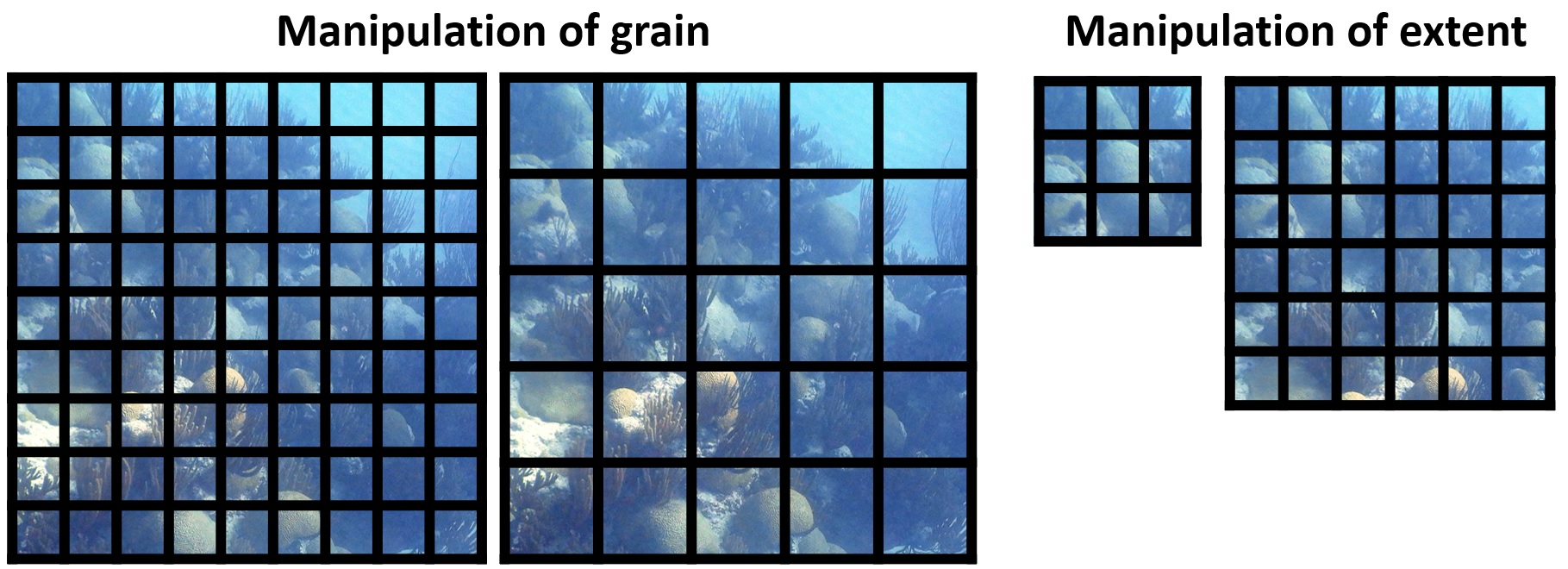
Scale sets the resolution under which we look at the world. The scale consists of two components: grain and extent. Grain sets the unit of observation. For an ecologist, it can be a quadrat, which they use to make observations; for a photographer, it is a pixel, which, combined with many others, comprise the whole picture. Extent is an area over which our observations are done. To stick to the original examples, for an ecologist, it would be the area between two furthermost quadrats; for a photographer, it would be set by the boundaries of the final picture. Both grain and extent can be manipulated. Here are two examples of hypothetical study grids. While the first one changes the grain of observation, keeping the extent same, the second keeps the same grain while changing the extent.
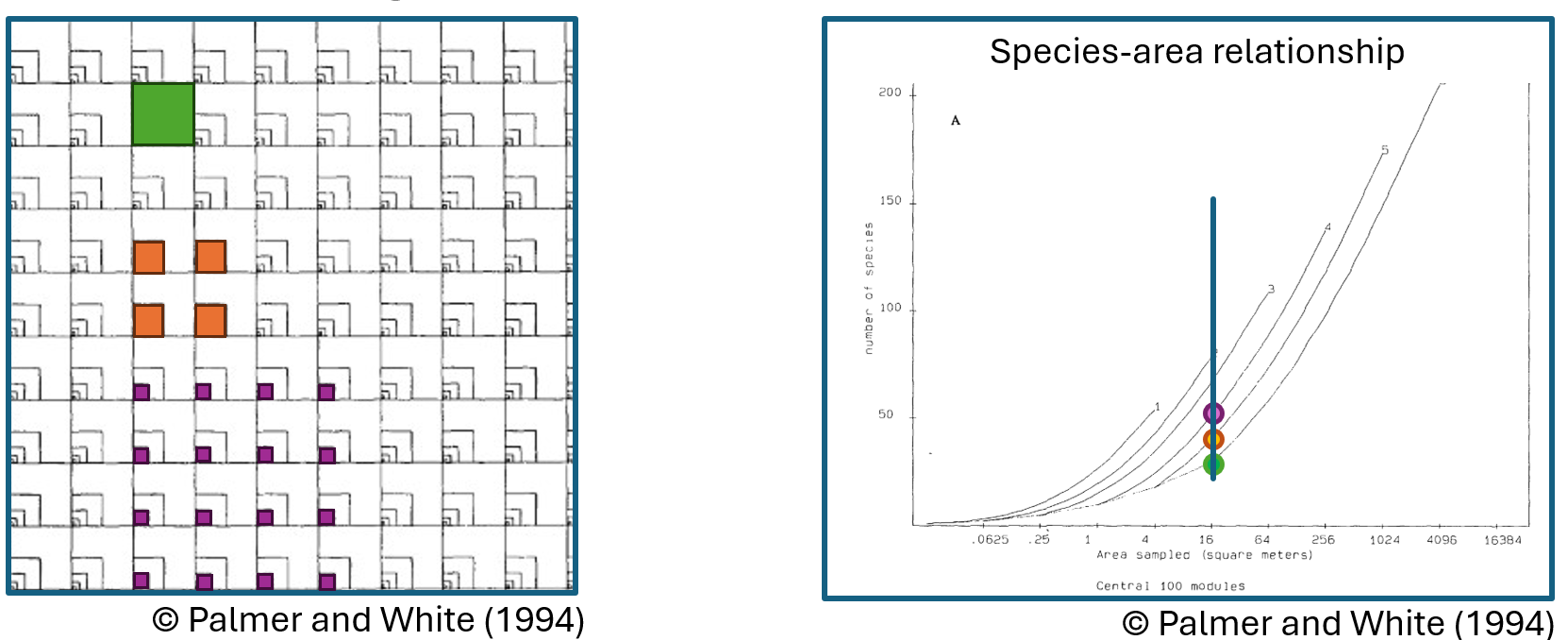
While this may seem trivial, researchers often forget that the grain and extent of observation can vastly change our results, even for such a substantial relationship as the one between area and number of observed species. This was proven in 1994 by Palmer and White in a study with a great observational experiment taking place in a forest in North Carolina. They sampled vascular plants using a special grid of nested quadrats. The quadrats of different sizes, therefore different grains, were called different levels. To sample an area of a given size, e.g. 16 square meters, one can sample one quadrat of level 6 (highest level), 4 quadrats of level 5, 16 quadrats of level 4, etc. As the quadrats of smaller levels are nested to the bottom left corners of the bigger ones, incorporating more of them also means spacing them further apart, to a bigger extent.
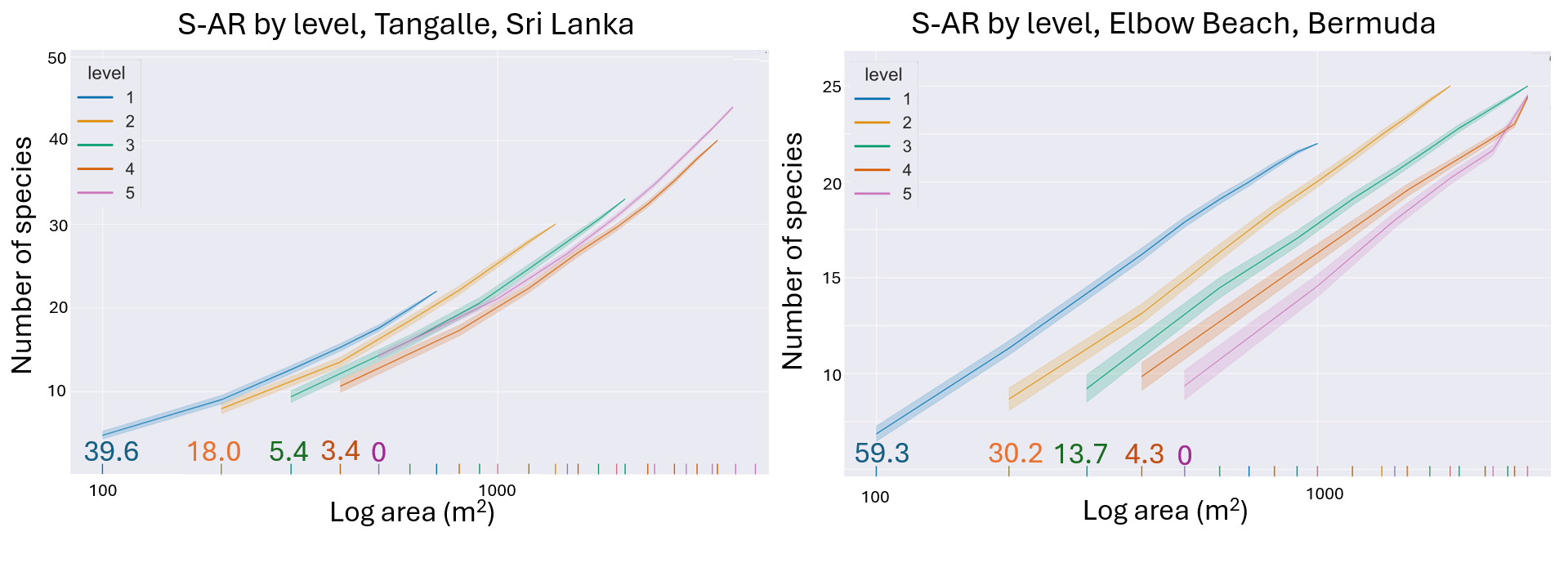
When species-area curves were made separately for each level of quadrats, Palmer and White noticed that the smaller quadrats spaced further apart incorporated more species for a given area than larger quadrats closer together. This means that quadrats of smaller grain with larger extent accumulate more species than quadrats of bigger grain with small extent.
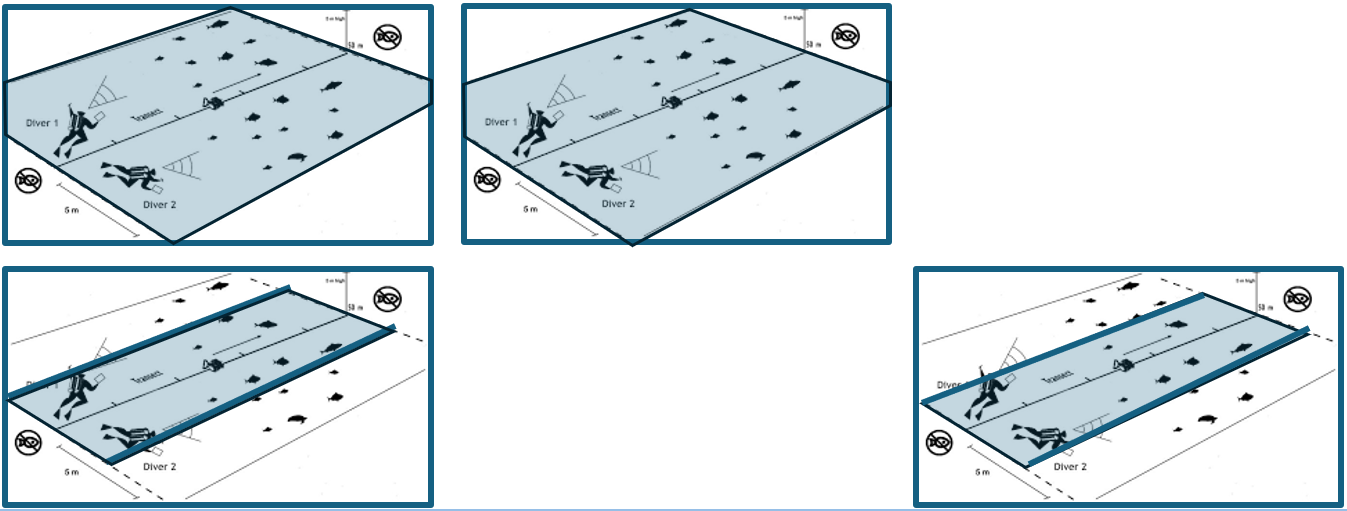
Data on fish biodiversity in global databases very often use different sampling protocols, which often differ in grain and extent of observation. For example, in an underwater visual census, the length or width of the belt transect sets its grain, while the spacing between such transects sets the extent of observation.
Realizing that different studies can indeed have different grains and extents of observation, our research question is: Is species richness of fishes on coral reefs influenced by grain and extent of observation?
To answer this question, we modified the data collection design by Palmer and White (1994) to be more suitable for coral reef fish, creating nested transects instead of nested quadrats. Data were collected in 3 localities in Sri Lanka and 7 localities in Bermuda. A new tool for analysis of the influence of grain and extent on perceived biodiversity, the SEAL, was created, and data were analysed using this software, following the methods of Palmer and White (1994).
Preliminary results from both Sri Lanka and Bermuda show that observational scale indeed influences percieved biodiversity of coral reef fishes. This influence exists even on the scale of one locality but is smaller than for immobile organisms such as plants. Our next steps lead to the perfection of SEAL and publication of our findings.